What Separates Good Hiring from Great Hiring
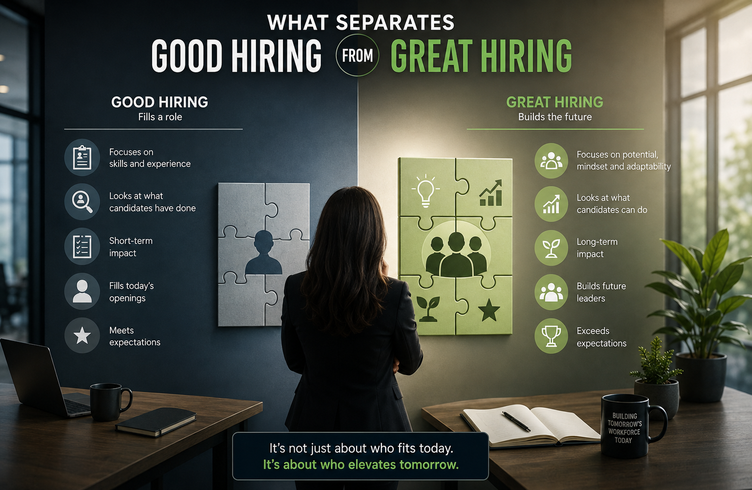
Most enterprise hiring functions are good. They fill roles. They manage pipelines. They produce hires that, in the majority of cases, perform adequately in the positions they were selected for. The process runs, the headcount is delivered, and the organization moves forward. By the metrics most commonly used to evaluate hiring performance, good is achievable and, in many organizations, consistently achieved.
But good hiring and great hiring are not simply different points on the same continuum. They are qualitatively different operating models, built on different foundational assumptions, generating different kinds of evidence, and delivering different levels of organizational value. The gap between them is not primarily a gap in effort or intent. It is a gap in infrastructure, governance, and the strategic discipline with which the hiring function is designed and operated.
For CHROs and Heads of Talent Operations who are accountable for workforce quality at a boardroom level, understanding what separates good hiring from great hiring is not an academic exercise. It is the diagnostic framework that identifies where the talent function is performing at the standard the organization requires and where it is falling short of the benchmark that genuine hiring excellence demands.
What Good Hiring Actually Looks Like
Good hiring, in the enterprise context, is characterized by a set of properties that most mature talent functions have developed to a reasonable degree. Roles are filled within acceptable timeframes. Candidate pipelines are managed efficiently. Interview processes are structured enough to produce defensible outcomes in most cases. Hiring managers are broadly satisfied with the candidates presented to them. And the mis-hire rate, while never zero, is not so high as to create a persistent organizational performance problem.
Good hiring is also characterized by what it lacks. It lacks the structured, decision-level data that would allow the organization to understand why its hiring decisions produce the outcomes they do. It lacks the funnel visibility that would identify where evaluation quality varies across teams, regions, and hiring managers in ways that produce inconsistent outcomes despite nominally identical processes. It lacks the governance architecture that would make hiring decisions defensible not just in most cases but in every case, against every standard of scrutiny the organization might face.
Good hiring produces acceptable results through a combination of reasonable process design and the accumulated judgment of experienced practitioners. It is sustainable as long as the environment in which it operates remains forgiving of the variability and opacity that characterize it. In 2026, that environment is becoming less forgiving by the quarter.
The First Hallmark of Great Hiring: Consistency as a Structural Property
The first and most fundamental hallmark that separates great hiring from good hiring is consistency, and the specific way in which that consistency is achieved.
Good hiring functions develop frameworks, communicate standards, train hiring managers, and expect that the combination of these inputs will produce reasonably consistent evaluation practice across the organization. In many cases, this aspiration is partially realized. But the consistency it produces is dependent on individual compliance with guidelines that are open to interpretation, and it deteriorates under the pressure of high hiring volumes, organizational change, and the natural variation in how different people apply any framework that was not designed to constrain interpretation precisely.
Great hiring functions achieve consistency structurally. The evaluation framework is not distributed as guidance to be applied individually. It is operationalized as the architecture within which every evaluation occurs, so that the criteria applied in one hiring decision are genuinely comparable to those applied in every other hiring decision across the enterprise.
Consistency is not a goal the process aims for. It is a property the process generates, because it was designed to generate it rather than to rely on individual discipline to approximate it.
This structural consistency is the foundation on which every other hallmark of great hiring is built. Without it, data is not comparable. Without comparable data, insight is not possible. Without insight, improvement is not systematic. And without systematic improvement, the hiring function cannot compound in quality over time in the way that great hiring demands.
The Second Hallmark: Governance That Creates Accountability at the Decision Level
The second hallmark of great hiring is governance that operates at the level of individual decisions rather than aggregate outcomes. This distinction is more significant than it might initially appear, and it is the point where most good hiring functions fall short of the great hiring standard.
Good hiring functions have governance. They have approval processes, diversity commitments, hiring manager accountability frameworks, and reporting structures that create organizational oversight of the talent acquisition function at a broad level. What they typically do not have is governance that operates at the level of the individual hiring decision, ensuring that the reasoning behind each decision meets a defined standard of rigor before the decision is finalized.
Great hiring functions treat every hiring decision as a governed organizational decision in the same way that significant financial or operational decisions are governed. The evidence supporting a hiring recommendation is structured and reviewable. The criteria applied to produce that recommendation are defined and documented. The process that generated the decision creates an audit trail that demonstrates its integrity to internal and external scrutiny without requiring reconstruction from memory and informal notes.
This decision-level governance is what transforms hiring accountability from a cultural expectation into a structural reality. It is also what creates the compliance posture that regulatory environments are increasingly demanding, and the legal defensibility that enterprise organizations increasingly require.
Great hiring functions do not hope their decisions were made well. They can demonstrate it, with structured evidence, at any point in the process and for any decision that is subject to review.
The Third Hallmark: Speed That Does Not Sacrifice Quality
The third hallmark of great hiring is the ability to operate with competitive speed without compromising the evaluation quality and governance discipline that the first two hallmarks require. This is the hallmark that most good hiring functions find most difficult to achieve, because they experience speed and quality as competing priorities rather than as complementary properties of a well-designed process.
The reason speed and quality appear to compete in most enterprise hiring functions is a process design problem rather than a fundamental tension. When evaluation quality depends on the thoroughness of individual human judgment, adding governance discipline tends to add time. When structured data generation requires additional documentation effort from hiring managers and interviewers, the governance layer creates friction that slows the process. And when compliance requirements add verification steps at stages that were not designed to accommodate them efficiently, speed suffers.
Great hiring functions resolve this apparent tension by designing the process so that structure, governance, and evidence generation are built into the evaluation architecture itself rather than added as supplementary requirements.
When every evaluation stage generates structured data as a natural output of how it operates rather than as an additional documentation task, the governance layer does not create friction. It creates efficiency, because the information needed for the next stage of the process is already organized, comparable, and available without the coordination overhead that unstructured data requires.
The result is a hiring process that moves faster than its less governed counterparts, not despite its structural discipline but because of it. The rework, late-stage misalignment, and calibration overhead that consume time in good hiring functions are eliminated by the structural coherence of a process designed to produce consistent, decision-ready evidence at every stage.
The Fourth Hallmark: Quality of Hire as a Measurable and Improving Metric
The fourth hallmark of great hiring is the ability to measure quality of hire with genuine precision and to use that measurement to drive continuous improvement in the decisions that produce it. This is the hallmark that most clearly distinguishes great hiring as an organizational capability rather than simply a better process.
Good hiring functions measure quality of hire in the ways that are currently standard across the industry: manager satisfaction surveys, retention rates at defined tenure milestones, and performance ratings in the first year of employment. These are legitimate proxies, and they provide a useful approximate picture of hiring quality at an aggregate level.
But they do not support the kind of precise, decision-level analysis that would identify which specific evaluation inputs are driving quality variation, why some hiring managers consistently produce stronger outcomes than their peers, or what changes to the evaluation framework would improve predictive accuracy in specific roles or functions.
Great hiring functions measure quality of hire by connecting structured evaluation inputs to downstream performance outcomes in a way that enables this level of analysis. They know not just that quality of hire is high or low in aggregate, but which criteria, which evaluation stages, and which process design elements are contributing most to the quality variation they observe.
And they use this knowledge to refine their evaluation frameworks continuously, compounding the predictive accuracy of their hiring decisions over time.
This continuous improvement capability is the strategic prize that the great hiring standard delivers above and beyond any other benefit. It is the mechanism by which the hiring function becomes genuinely smarter with each cycle, building organizational intelligence about what good hiring looks like for the specific needs of the specific enterprise that cannot be replicated by any organization that has not built the same structured data infrastructure over the same sustained period.
The Gap Between Good and Great in Practice
The practical gap between good and great hiring is most visible at the moments when the hiring function comes under scrutiny.
A board question about hiring quality consistency across regions. A regulatory inquiry into the documentation practices around a particular class of hiring decisions. A budget review demanding ROI evidence that connects hiring investment to workforce performance outcomes. A legal challenge requiring the organization to demonstrate that a rejected candidate was evaluated against consistently applied, job-relevant criteria.
Good hiring functions struggle at these moments not because their decisions were necessarily wrong but because they were never made through a process designed to produce the evidence that these moments require.
The decisions happened. The reasoning behind them existed, at least implicitly, in the minds of the people who made them. But the structured, reviewable, audit-ready record of that reasoning does not exist, because the process that produced the decisions was never designed to generate it.
Great hiring functions are built for these moments. The evidence exists because it was generated as a natural output of a process designed to produce it. The answers to hard questions are available not because someone thought to prepare them in advance but because the hiring function operates in a way that makes the evidence continuously available as a structural property of how it works.
Building Toward the Great Hiring Standard
Moving from good to great hiring requires a deliberate investment in the infrastructure that makes consistency, governance, speed, and quality of hire measurable properties of the process rather than aspirational outcomes of individual effort.
That investment is not incremental. It is architectural.
ACHNET was built to support this architectural shift. AI Super Agent iJupiter™ operationalizes the four hallmarks of great hiring within the process itself, ensuring that consistency is structural rather than aspirational, that governance operates at the decision level rather than the outcome level, that speed and quality reinforce each other rather than competing, and that quality of hire is measurable and continuously improving rather than approximate and static.
For CHROs and Heads of Talent Operations who are accountable for delivering the great hiring standard at enterprise scale, AI Super Agent iJupiter™ is the infrastructure that makes that standard operational rather than aspirational, across every team, every region, and every hiring cycle.
Where the Standard Is Heading
The benchmark for great hiring is not static. As board expectations rise, regulatory environments tighten, and the competitive pressure on talent quality intensifies, the standard that separates great hiring from good hiring will continue to move.
The organizations that are building toward great hiring now are not simply meeting today's standard. They are establishing the foundational capability that will allow them to meet tomorrow's standard as it evolves, because the infrastructure they are building is designed to improve continuously rather than to deliver a fixed level of performance.
The organizations that remain at the good hiring standard while the great hiring benchmark rises will find the gap between their talent function's capability and their organization's expectation widening in ways that become increasingly difficult to close from a standing start.
The compounding advantage of structured data, governance discipline, and continuously improving predictive accuracy is not replicable quickly, and the time to build it is before the gap becomes visible rather than after.
Conclusion: The Standard Is Set. The Infrastructure Must Rise to Meet It.
Good hiring is achievable. Great hiring is a governance capability built on the infrastructure of structural consistency, decision-level accountability, process-driven speed, and measurable, continuously improving quality of hire.
The gap between the two is not a matter of effort or intention. It is a matter of process architecture. And in 2026, the organizational stakes of remaining at the good hiring standard while the expectation rises to great are significant enough that the investment in closing that gap has become one of the most consequential decisions on the CHRO agenda.
As enterprise hiring continues to evolve, AI-driven systems are playing an increasingly central role in making the great hiring standard operational at scale. AI Super Agent iJupiter™ helps CHROs and Heads of Talent Operations build the structural consistency, governance discipline, and evidence-generating infrastructure that separates great hiring from good, enabling enterprise talent functions to meet the boardroom standard that 2026 demands and that the years ahead will require even more.
ACHNET is a unified talent selection platform powered by its AI Super Agent, iJupiter™, designed to help businesses hire faster, smarter, and with greater confidence. It brings together sourcing, talent assessments, AI video interviews, and an Applicant Ranking System into one seamless workflow, enabling hiring teams to evaluate candidates based on real skills, structured insights, and verified data. With built-in fraud detection and decision-ready reports, ACHNET helps organizations reduce time-to-hire, improve quality of hire, and make consistent, data-driven hiring decisions at scale.
Book a Demo
If your hiring function is performing well by conventional metrics but falling short of the governance, consistency, and evidence quality that boardroom accountability now requires, the gap between good and great hiring may be wider than your current reporting reveals.
ACHNET helps enterprise CHROs and Heads of Talent Operations build the infrastructure that closes that gap, delivering the structural consistency, decision-level governance, and measurable quality of hire improvement that defines the great hiring standard.
Book a demo to see how AI Super Agent iJupiter™ helps your talent function move from good to great, and what that difference means for your organization's workforce quality and strategic performance.