From Reactive to Strategic: How CHROs Are Building Intelligent Hiring Functions in 2026
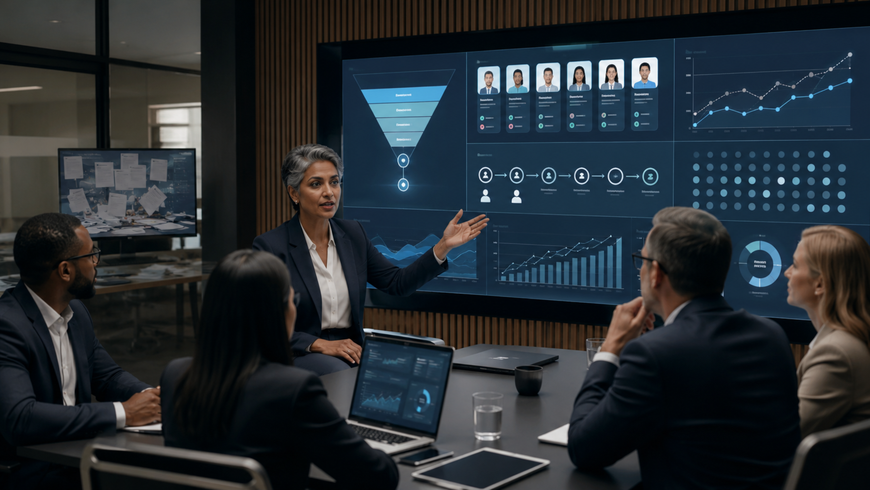
There is a transformation underway in the most forward-thinking enterprise talent functions in 2026. It is not a transformation driven by a new technology platform or a revised hiring framework. It is a transformation in the fundamental operating model of the talent acquisition function itself, from a reactive administrative capability that responds to headcount demands as they arise, to a strategic organizational function that anticipates workforce needs, governs hiring decisions with the rigor of a critical business process, and generates the structured intelligence that enterprise leadership now expects from every function that carries significant organizational impact.
This transformation is not happening uniformly across enterprise organizations. It is happening in the ones where CHROs have made a deliberate decision to invest in the foundational infrastructure that makes strategic operation possible, and where that investment is being made with a clarity of purpose that distinguishes it from the incremental process improvements that most talent functions have historically pursued.
Understanding what this transformation requires, what it delivers, and why the organizations that are building it now are establishing an advantage that will compound significantly over the years ahead is the strategic conversation that every enterprise executive and CHRO needs to be having in 2026.
The Reactive Hiring Function and Its Limits
A reactive talent acquisition function is not a failed one. In many organizations, the reactive model has served well enough for long enough that its limitations have been accepted as inherent properties of hiring rather than as consequences of a specific operating model that can be changed.
The reactive hiring function operates on demand. A vacancy arises, and the process activates. Candidates are sourced, evaluated, and selected through a process that is broadly consistent in its stages but highly variable in the quality of its execution. Decisions are made, hires are onboarded, and the function moves to the next open role.
The cycle repeats, each iteration largely independent of the last, because the data generated by the previous cycle was never structured in a way that would allow it to inform the next one.
This model has real costs that its apparent functionality conceals. It cannot anticipate capability gaps before they become vacancies. It cannot identify which evaluation practices are producing strong hires and which are generating risk. It cannot demonstrate its contribution to organizational performance with the evidence quality that executive leadership now demands.
And it cannot improve systematically, because the feedback loop that systematic improvement requires, the connection between structured evaluation inputs and measurable workforce outputs, was never built into how the function operates.
In 2026, the limits of this model are no longer concealed by its functionality. The expectations placed on the talent function have risen past what a reactive operating model can meet, and the CHROs who recognize this are building something fundamentally different.
What the Strategic Hiring Function Looks Like
The strategic hiring function does not simply move faster or hire more efficiently than the reactive one. It operates from a different set of foundational assumptions about what the talent acquisition function is for and what it is capable of producing.
Where the reactive function treats each hiring decision as an independent event to be managed, the strategic function treats every hiring decision as a data-generating organizational event that contributes to a continuously improving body of evidence about what good hiring looks like for the specific needs of the enterprise.
Where the reactive function measures success by the completion of the hire, the strategic function measures success by the quality and defensibility of the decision that produced it, and by the contribution of that decision to the organizational intelligence that the next decision will benefit from.
The strategic hiring function is also fundamentally different in its relationship to organizational leadership. Rather than reporting to the business after hiring decisions have been made, it operates as a governed organizational process that generates structured evidence for leadership review throughout the process.
This is similar to how significant financial or operational decisions are reviewed against defined criteria before they are finalized rather than reported on after the fact.
This repositioning of the talent function from a service that delivers headcount to a governed process that delivers strategic workforce intelligence is the transformation that the most forward-thinking CHROs are building toward.
Structured Assessment as the Intelligence Foundation
The first element of the transformation from reactive to strategic is the redesign of assessment from an evaluation tool into an intelligence-generating infrastructure.
Assessment in a reactive hiring function is designed to evaluate candidates well enough to support a hiring decision. It identifies who performed adequately against a set of criteria that may or may not be precisely defined, consistently applied, or meaningfully connected to the downstream performance outcomes that the hire is expected to produce.
The assessment generates a decision. It does not generate intelligence.
Structured assessment in a strategic hiring function is designed differently. The criteria it applies are defined with enough precision to constrain interpretation and produce comparable outputs across every candidate who passes through the same stage.
The scoring it generates is structured in a format that supports longitudinal analysis, connecting evaluation inputs to performance outcomes over time and enabling the continuous refinement of assessment criteria based on what the evidence shows.
The data it produces is integrated with the outputs of every other evaluation stage, building a coherent and analyzable candidate picture that supports a hiring decision grounded in structured evidence rather than aggregate impression.
This is the assessment design that generates hiring intelligence rather than simply hiring decisions.
It is also the foundation on which every other element of the strategic hiring function is built, because without structured assessment data, funnel governance has nothing meaningful to govern, and hiring data has nothing useful to analyze.
Funnel Governance as the Accountability Architecture
The second element of the transformation is funnel governance, the accountability architecture that ensures every stage of the hiring process operates with the consistency, transparency, and defensibility that strategic organizational decision-making requires.
Reactive hiring functions have process. Strategic hiring functions have governance.
The difference is significant. Process describes what should happen at each stage of the hiring funnel. Governance ensures that what actually happens meets the defined standard, generates the structured evidence that the next stage requires, and creates the audit trail that demonstrates the integrity of the full process.
Funnel governance in a strategic hiring function means that evaluation criteria are reviewed for alignment before the process begins, ensuring that what is assessed at screening is coherently connected to what is evaluated at interview and what is weighted in the final decision.
It means that evaluation quality is monitored across stages, teams, and regions, so that inconsistency is identified and addressed at the process level rather than absorbed into variable hiring outcomes.
It also means that the documentation generated at each stage is structured, reviewable, and sufficient to support the decision that follows without requiring reconstruction from memory or informal notes.
This governance architecture transforms the hiring function from a process that produces outcomes into one that produces accountable decisions.
Hiring Data as the Strategic Differentiator
The third element of the transformation is the development of hiring data from a reporting input into a strategic organizational asset.
A reactive hiring function generates data as a byproduct of its operations. That data describes what happened in formats that support aggregate reporting but not decision-level analysis.
A strategic hiring function generates data as a primary output of its process design, in formats that support the specific analytical questions that strategic talent leadership requires.
When hiring data is structured, decision-level, and longitudinally connected to workforce outcomes, it becomes the raw material for a continuously improving organizational understanding of what good hiring means in the specific context of the enterprise.
It can reveal which evaluation signals are genuinely predictive of performance in specific roles. It can identify where evaluation quality varies across the organization and what that variation may cost in terms of workforce quality and mis-hire risk.
It can also help demonstrate the ROI of hiring investment with the evidence precision that board-level accountability increasingly demands.
This is the data capability that positions the talent function as a strategic business function rather than an administrative one.
The Role of AI Super Agent iJupiter™ in Making This Transformation Operational
The transformation from reactive to strategic hiring is architecturally clear. The challenge that has historically limited its implementation at enterprise scale is operational.
Building and sustaining the infrastructure of structured assessment, funnel governance, and strategic data generation across the volume, complexity, and organizational diversity of enterprise hiring requires a level of consistency and coordination that manual process management cannot reliably produce.
This is the operational challenge that ACHNET and AI Super Agent iJupiter™ were built to address.
Rather than asking hiring managers, recruiters, and compliance teams to operationalize a structured, governed, intelligence-generating hiring process through individual effort and discipline, AI Super Agent iJupiter™ embeds these requirements into the architecture of the process itself.
It helps ensure that structured assessment criteria are applied consistently across evaluation stages, hiring managers, and regions. It generates the decision-level data that funnel governance requires as a natural output of the evaluation process.
It also supports the longitudinal data infrastructure needed to transform hiring outcomes into organizational intelligence, connecting evaluation inputs to workforce outcomes in a format that enables continuous improvement.
For CHROs and enterprise executives who are ready to make the transformation from reactive to strategic hiring operational rather than aspirational, AI Super Agent iJupiter™ provides the infrastructure layer designed to support this shift at enterprise scale.
The Compounding Advantage of Strategic Hiring
The organizations furthest along in this transformation are beginning to demonstrate advantages that are not always fully visible in conventional hiring metrics but can become increasingly significant over time.
Their hiring functions can improve with each cycle because the structured data they generate enables continuous refinement of evaluation criteria based on evidence rather than assumption.
Their compliance posture can strengthen over time because the documentation discipline embedded in their governance architecture produces an increasingly robust audit trail.
Their conversations with boards and executive leadership around talent can become more confident and productive because the evidence quality they can produce in response to questions about hiring quality and ROI improves as their data infrastructure matures.
Their competitive position in the talent market can also strengthen because the compounding quality improvement of a strategically governed hiring function produces a workforce built through increasingly reliable selection rather than accumulated process variability.
Where the Transformation Leads
The endpoint of the transformation from reactive to strategic hiring is not simply a better version of the current talent acquisition function. It is a fundamentally different organizational capability.
It operates with the governance discipline, evidence quality, and strategic intelligence that the CHRO role increasingly demands.
The organizations that complete this transformation can strengthen workforce quality, manage hiring risk from a position of greater structural consistency, and demonstrate the ROI of people investment with evidence that supports executive-level decision-making.
They can also build a compounding intelligence advantage that helps make each subsequent talent decision more informed than the last.
The infrastructure to support this transformation exists. The organizations that begin building it now are establishing the foundation for strategic talent leadership in 2026 and beyond.
Conclusion: The Transformation Is the Strategy
Moving from reactive to strategic hiring is not simply an improvement initiative. It is a strategic repositioning of the talent function as a governed, intelligence-generating organizational capability.
The infrastructure that makes this repositioning operational, structured assessment, funnel governance, and strategic hiring data, is increasingly becoming a present priority for CHROs who want to build a talent function that leads rather than follows, governs rather than reacts, and demonstrates its strategic value through structured evidence.
As enterprise hiring continues to evolve, AI-driven systems are playing an increasingly central role in making this transformation operational at scale.
AI Super Agent iJupiter™ helps organizations build a structured, governed, intelligence-generating hiring foundation that can transform the talent function from a reactive necessity into a strategic organizational capability, one that operates with accountability and delivers increasing value with every hiring decision.
About ACHNET
ACHNET is a unified talent selection platform powered by its AI Super Agent, iJupiter™, designed to help businesses hire faster, smarter, and with greater confidence.
It brings together sourcing, talent assessments, AI video interviews, and an Applicant Ranking System into one seamless workflow, enabling hiring teams to evaluate candidates based on real skills, structured insights, and verified data.
With built-in fraud detection and decision-ready reports, ACHNET helps organizations reduce time-to-hire, improve quality of hire, and make consistent, data-driven hiring decisions at scale.
Schedule a Demo
The transformation from reactive to strategic hiring does not happen through better intentions or more rigorous guidelines alone. It requires infrastructure that makes structured assessment, funnel governance, and strategic hiring data operational at enterprise scale.
ACHNET helps CHROs and enterprise executives build an intelligent hiring foundation that supports stronger evidence, greater governance discipline, and continuous improvement.
Lead with confidence. Schedule a demo to see how AI Super Agent iJupiter™ can help transform your hiring function from reactive to strategic and strengthen workforce quality and long-term performance.