What Is Hiring Intelligence, And Why Every CHRO Needs It in 2026
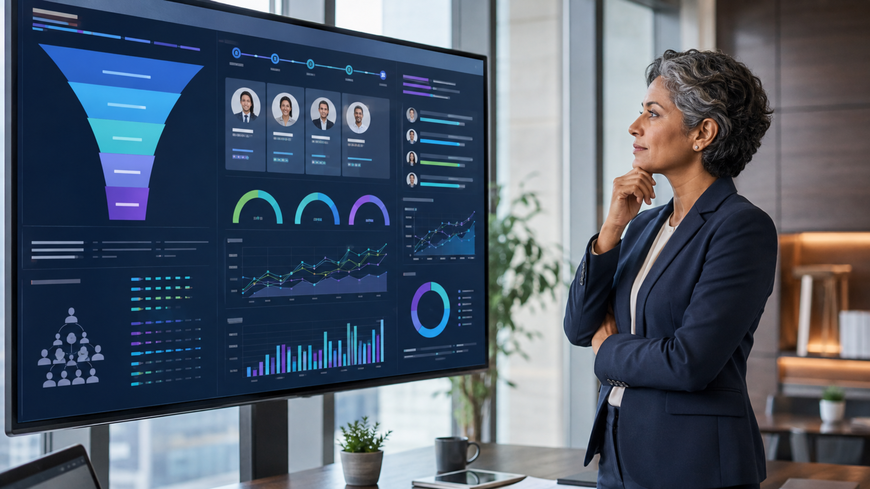
There is a term that is beginning to appear with increasing frequency in conversations about the future of enterprise talent leadership. It is not a product category or a vendor designation. It is a capability description, one that captures something that the most forward-thinking CHROs are actively building toward and that most enterprise hiring functions are still a significant distance from achieving.
Hiring intelligence is the organizational capability to make talent decisions on the basis of structured, analyzable, and continuously improving evidence about how those decisions are made, what inputs drive them, and what outcomes they produce. It is the difference between a hiring function that generates activity and one that generates insight. Between a process that produces headcount and one that produces organizational knowledge. Between a talent function that reports what happened and one that understands why, and uses that understanding to make every subsequent decision better than the last.
In 2026, hiring intelligence is not a future aspiration for the most strategically serious CHROs. It is an urgent operational priority. And understanding what it means, what it requires, and why it matters at a boardroom level is the starting point for building a talent function capable of meeting the moment.
Why the Term Matters and What It Actually Means
The language used to describe hiring capability has evolved considerably over the past decade. Organizations have invested in talent analytics, people data, workforce intelligence, and HR technology platforms that promise increasingly sophisticated insight into their hiring functions. Yet despite this investment, most CHROs in 2026 find themselves unable to answer the questions that hiring intelligence would make straightforward.
Why did our hiring quality vary so significantly across regions last quarter? Which evaluation criteria are actually predictive of performance in our senior leadership roles? Where in our hiring funnel are we losing the candidates we most need to retain? Is our assessment process generating reliable signals or creating false confidence in decisions that the data does not support?
These are not exotic questions. They are the questions that any strategically governed hiring function should be able to answer with structured evidence. The fact that most cannot reflects not a lack of data but a lack of hiring intelligence, the specific kind of structured, decision-level insight that transforms raw hiring data into organizational knowledge.
Hiring intelligence is built on four interconnected components, each of which is necessary and none of which is sufficient on its own. Understanding these components is essential for any CHRO who is serious about building this capability within their organization.
The First Component: Structured Data at the Decision Point
The foundation of hiring intelligence is structured data generated at the point where hiring decisions are actually made. Not aggregate outcome data collected after the fact, and not the unstructured qualitative impressions that most evaluation processes currently produce. Structured data means evaluation evidence that is defined, comparable, and analyzable across candidates, interviewers, teams, regions, and hiring cycles.
This distinction matters more than it might initially appear. Most enterprise hiring functions generate significant data volume. ATS systems track candidate movement through pipeline stages. Assessment platforms produce scores and completion records. Interview scheduling tools generate activity logs. But none of this is decision-level data in the sense that hiring intelligence requires. It is process activity data, which describes what happened without explaining how or why the decisions that drove those activities were made.
Decision-level structured data means knowing not just that a candidate was advanced or rejected at a particular stage, but what criteria were applied to that decision, how each criterion was scored, whether the scoring was consistent with how the same criteria were applied to other candidates in the same cohort, and whether the evidence gathered at that stage was sufficient to support the decision that followed. This is the data that makes hiring intelligence possible. And it is only generated when the evaluation process is designed from the ground up to produce it.
For CHROs, the implication is clear and consequential. Hiring intelligence cannot be built on top of a process that was never designed to generate structured decision data. It requires redesigning the evaluation architecture so that structure is a property of how decisions are made, not an attempt to impose order on data that was produced without it.
The Second Component: Funnel Visibility Across the Full Process
The second component of hiring intelligence is visibility into the hiring process at the level of individual decisions across the full funnel, not just at the aggregate outcome level that most reporting currently provides.
Funnel visibility means being able to see, in a structured and analyzable format, how evaluation quality varies across stages, interviewers, panels, and business units. It means being able to identify where in the process strong candidates are being lost, whether because of legitimate evaluation outcomes or because of process design failures that are screening out people who should have advanced. It means being able to track whether the criteria applied at the screening stage are coherently aligned with the criteria applied at the interview stage, and whether the data gathered across both stages is being synthesized into hiring decisions in a way that reflects the full evidential picture rather than the most recent impression.
This level of visibility is currently absent in most enterprise hiring functions, and its absence has consequences that extend well beyond operational efficiency. Without funnel visibility at the decision level, CHROs cannot identify the specific points where process design is failing. They cannot distinguish between a talent shortage and an evaluation design problem. They cannot determine whether a pattern of poor hiring outcomes in a particular function reflects market conditions, sourcing strategy failures, or systematic inconsistency in how candidates are being assessed.
Funnel visibility is what transforms a collection of hiring outcomes into a coherent picture of how the hiring process is performing, where it is working well, and where investment in redesign would produce the greatest improvement in decision quality and organizational outcome.
The Third Component: Predictive Insight That Improves Over Time
The third component of hiring intelligence is the capability that distinguishes a genuinely intelligent hiring function from one that is simply better at describing what has already happened. Predictive insight is the ability to use structured historical data about hiring decisions and their downstream outcomes to improve the accuracy of future decisions.
This is the component of hiring intelligence that carries the most significant long-term strategic value, and it is the one that requires the longest sustained investment to build. Predictive insight is not generated by a single data collection initiative or a one-time analytics project. It is built over time, through the accumulation of structured decision data that can be connected to performance outcomes, retention data, and organizational capability assessments in a way that reveals which evaluation signals are genuinely predictive and which are generating noise.
When a hiring function has built this predictive capability, the quality of its decisions improves continuously and compoundingly. Each hiring cycle generates new data that refines the understanding of which candidate signals correlate with strong performance in specific roles. Each evaluation framework is progressively calibrated against evidence rather than assumption. And each hiring decision benefits from the accumulated intelligence of every prior decision made through the same structured process.
This compounding improvement is the strategic prize that hiring intelligence makes available. It is not accessible to organizations operating through unstructured, variable hiring processes that generate outcome data without the decision-level evidence needed to connect inputs to outcomes. And it represents an organizational advantage that, once established, becomes increasingly difficult for competitors to replicate quickly.
The Fourth Component: Decision Accountability That Holds Up to Scrutiny
The fourth component of hiring intelligence is decision accountability, the governance layer that ensures every hiring decision can be reviewed, explained, and defended against the standard of rigor that enterprise leadership, regulatory bodies, and legal scrutiny now require.
Decision accountability in a hiring intelligence framework is not simply documentation. It is the structural property of a hiring process that makes the reasoning behind every decision visible, comparable, and audit-ready at the point where the decision is made, not reconstructed after the fact from memory and informal notes.
This component of hiring intelligence has become increasingly urgent in 2026 for reasons that extend across multiple dimensions of enterprise risk. Regulatory environments governing hiring practices are tightening in multiple jurisdictions. Board-level expectations around the defensibility of talent decisions are rising. And the legal exposure associated with hiring decisions that cannot be explained with reference to consistently applied, job-relevant criteria is growing in both frequency and consequence.
Decision accountability is what allows a CHRO to walk into a board meeting, a regulatory review, or a legal proceeding with confidence that the hiring function's decisions were made through a governed process that meets the standard of rigor being demanded. It is the difference between a talent function that hopes its decisions were made well and one that can demonstrate it with structured evidence.
Why 2026 Is the Inflection Point
The four components of hiring intelligence, structured data at the decision point, funnel visibility across the full process, predictive insight that improves over time, and decision accountability that holds up to scrutiny, have been recognizable as strategic priorities for several years. What makes 2026 the inflection point for building this capability is the convergence of pressures that make operating without it no longer sustainable for enterprise CHROs who are serious about their organizational mandate.
Board expectations have crystallized around a demand for evidence quality that talent functions built on unstructured processes cannot produce. Regulatory environments have tightened in ways that make the documentation gaps of ungoverned hiring processes a direct compliance liability. AI-driven fraud patterns have reached a sophistication that makes the verification and consistency gaps of most current hiring processes a material organizational risk. And the competitive pressure on talent quality has intensified to the point where the compounding advantage of a predictively improving hiring function is no longer a theoretical benefit but a measurable competitive differentiator.
The CHROs who are building hiring intelligence now are responding to these converging pressures with the only response that addresses all of them simultaneously: a structured, governed, evidence-generating hiring function that operates at the standard every pressure on the CHRO agenda is demanding.
Building Hiring Intelligence at Enterprise Scale
The operational challenge of building hiring intelligence is not conceptual. The four components are clear. The value they deliver is well understood by the CHROs who are most seriously pursuing this capability. The challenge is building the infrastructure that makes all four components operational simultaneously, at the volume and complexity that enterprise hiring requires, without creating a documentation and governance burden that slows the process to the point of operational dysfunction.
This is precisely the challenge that intelligent systems are designed to address. ACHNET was built to operationalize hiring intelligence at enterprise scale. AI Super Agent iJupiter™ works within the hiring process to generate structured decision data at every evaluation touchpoint, create funnel visibility across every stage and every region, build the evidence base that predictive insight requires, and maintain the decision accountability architecture that governance and compliance demand.
Rather than asking hiring managers, recruiters, and compliance teams to build and sustain this infrastructure through individual effort and discipline, AI Super Agent iJupiter™ embeds it into the process architecture itself. The result is a hiring function where intelligence is not a project to be built alongside the process but a structural property of how the process operates, generating value with every hiring decision rather than requiring separate investment to produce.
For CHROs who are ready to move their talent function from a process that produces headcount to one that produces organizational intelligence, AI Super Agent iJupiter™ is the infrastructure layer that makes that transition operational rather than aspirational.
What Hiring Intelligence Changes for the CHRO
The practical impact of hiring intelligence on the CHRO's organizational position is significant and immediate. With structured decision data, funnel visibility, predictive insight, and decision accountability in place, the nature of the conversations a CHRO can have at the board level changes entirely.
Budget justification becomes a data-supported narrative rather than a strategic argument. Risk management becomes a process architecture conversation rather than a reactive incident response. Workforce quality improvement becomes a continuous, evidence-driven initiative rather than a periodic program intervention. And the strategic value of the people function becomes demonstrable with the evidence quality that executive leadership now expects, rather than asserted on the basis of outcomes that cannot be fully explained.
This is the organizational position that hiring intelligence creates. Not simply a better hiring process, but a fundamentally stronger CHRO mandate, backed by the structured evidence that transforms talent leadership from a function that manages people decisions into one that governs them with the rigor and accountability that enterprise performance demands.
Conclusion: Intelligence Is the Infrastructure That Everything Else Requires
Hiring intelligence is not a feature of a more sophisticated ATS or an output of a better analytics dashboard. It is an organizational capability built on the foundational infrastructure of structured evaluation, funnel governance, and decision accountability, and it is the capability that every other people strategy initiative either depends on or is constrained by.
In 2026, building this capability is not a future investment to be planned. It is a present priority that the convergence of board expectations, regulatory demands, fraud risk, and competitive talent pressure has made urgent for every CHRO who is serious about leading their function at the level the moment requires.
As enterprise hiring continues to evolve, AI-driven systems are playing an increasingly central role in making hiring intelligence operational at scale. AI Super Agent iJupiter™ helps CHROs build the structured, governed, evidence-generating hiring foundation that transforms the talent function into an organizationally intelligent capability, one that leads with data, governs with accountability, and improves continuously with every decision it makes.
ACHNET is a unified talent selection platform powered by its AI Super Agent, iJupiter™, designed to help businesses hire faster, smarter, and with greater confidence. It brings together sourcing, talent assessments, AI video interviews, and an Applicant Ranking System into one seamless workflow, enabling hiring teams to evaluate candidates based on real skills, structured insights, and verified data. With built-in fraud detection and decision-ready reports, ACHNET helps organizations reduce time-to-hire, improve quality of hire, and make consistent, data-driven hiring decisions at scale.
Schedule a Demo
Hiring intelligence is the capability that transforms a talent function from one that reports outcomes to one that governs decisions, and it is built on infrastructure that most enterprise hiring processes do not yet have in place.
ACHNET helps CHROs build the structured evaluation frameworks, funnel visibility, and decision accountability architecture that make hiring intelligence operational at enterprise scale.
Lead 2026 with confidence. Schedule a demo to see how AI Super Agent iJupiter™ gives your hiring function the intelligence infrastructure it needs to perform at the standard your organization now demands.